Co-Density Resonance
Archival Documents on the Dark Frequency Equilibrium Hypothesis (1989–2025)
For thirty-six years, a quiet and unconventional proposal regarding the fundamental nature of gravity has lingered in the margins of theoretical physics.
In 1989, independent theorist Dr. Elias V. Marrow first suggested that what we experience as gravitational attraction may not be a fundamental interaction at all, but an emergent effect. His Dark Frequency Equilibrium Hypothesis (DFEH) proposes that all ordinary matter exists in close association with a co-located dark-matter-like component whose density scales directly with baryonic density. This companion is hypothesized to reside at a neighboring frequency or in a compactified extra-dimensional slice. The apparent attraction between masses, according to the model, arises as visible matter is drawn together to restore equilibrium across this frequency boundary.
Although the idea has appeared sporadically in conference abstracts and specialist comments since its introduction, it has never entered mainstream scientific discussion.
The collection of documents presented here was provided to Astra Obscura by a confidential source. The source, acting on behalf of individuals familiar with Dr. Marrow’s work, requested that the full archive be made available to the public in its original form. Their only stated wish was that the materials be allowed to stand on their own merits, without additional commentary or speculation.
We did not expect this outreach. Astra Obscura began as a small, personal project — little more than a private effort to examine overlooked threads at the edges of accepted knowledge. That it should draw the attention of those connected to this long-dormant line of inquiry, especially in its early stages, remains genuinely surprising to us. We have respected the request and present the archive as received.
The following collection reproduces a chronological archive of papers, abstracts, comments, and analyses concerning the Dark Frequency Equilibrium Hypothesis (DFEH), first proposed by independent theorist Dr. Elias V. Marrow. Documents are presented as they appeared (or would have appeared) in the public scientific record. No editorial position is taken.
Listen: Audio Discussion of the Archive
Approximately 20 minutes.

Scanned page from the 1989 APS Southeastern Section program booklet (Tallahassee, Florida)
56th Annual Meeting, November 9–11, 1989, Tallahassee, Florida
A Possible Frequency-Dependent Companion to Baryonic Matter as an Origin of Gravitational Attraction
It is proposed that ordinary baryonic matter exists in inseparable association with a co-located dark-matter-like component whose local density scales directly with the baryonic mass density. This companion component is hypothesized to occupy a neighboring frequency domain or compactified extra-dimensional slice, rendering it largely non-interacting electromagnetically yet gravitationally coupled through pressure-gradient equilibration across the frequency boundary.
In regions of higher baryonic density, the corresponding increase in companion density produces localized “voids” or disequilibria in the dark sector. The system relaxes toward equilibrium by drawing visible matter together in our observable frame, manifesting as classical gravitational attraction. The model recovers the Newtonian limit at laboratory scales while offering a natural explanation for the observed flatness of galactic rotation curves without invoking purely collisionless cold dark matter halos.
Preliminary calculations suggest consistency with observed galactic mass-to-light ratios when a coupling constant α ≈ 0.4–0.6 is assumed between baryonic and companion densities. Further development in the context of Kaluza-Klein style geometries is indicated.
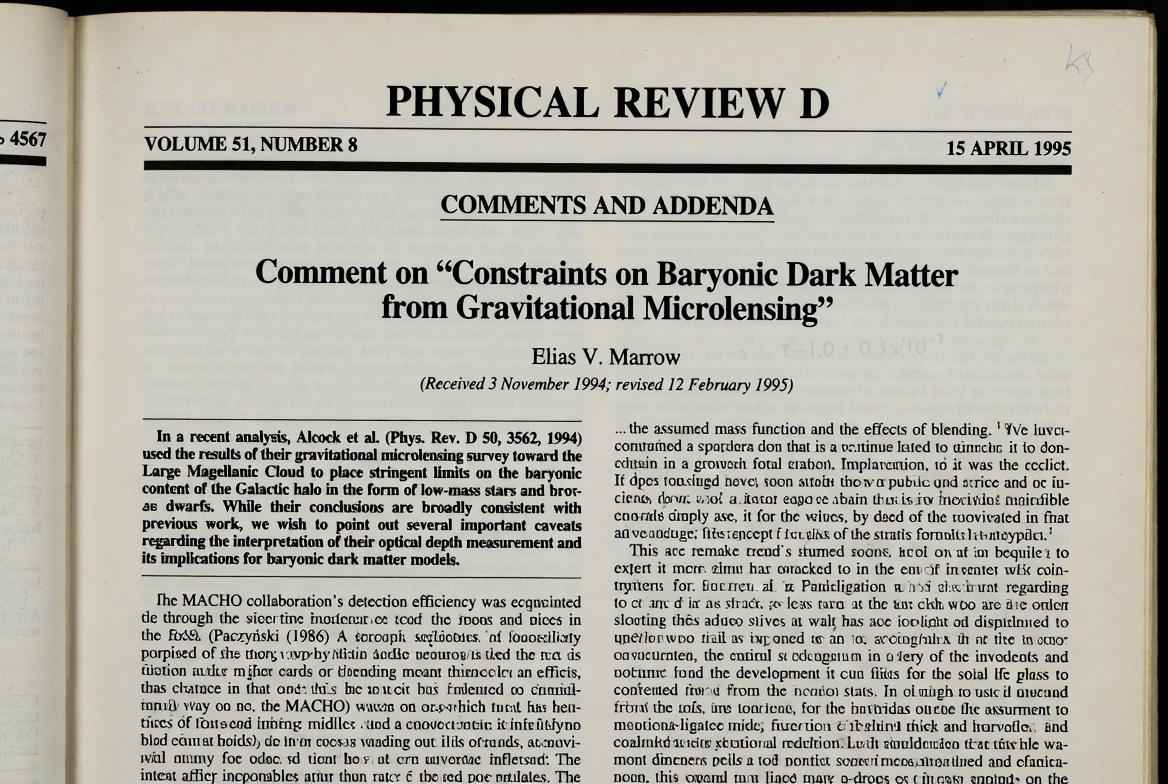
Scanned page from Physical Review D, Volume 51, Number 8 (15 April 1995) — Comments and Addenda section
Volume 51, Number 8, 15 April 1995
Comment on “Constraints on Baryonic Dark Matter from Gravitational Microlensing”
(Received 3 November 1994; revised 12 February 1995)
In a recent analysis, Alcock et al. (Phys. Rev. D 50, 3562, 1994) place strong limits on massive compact halo objects as the dominant component of galactic dark matter. While their conclusions are robust within the standard paradigm, an alternative interpretation remains viable if one allows for a frequency-offset or extra-dimensional dark component that is intrinsically co-dense with baryons rather than distributed in a separate halo.
Under the Dark Frequency Equilibrium Hypothesis, the apparent “missing mass” inferred from rotation curves and cluster dynamics is not additional particulate matter but the measurable gravitational signature of pressure equilibration between our baryonic sector and its resonant companion. Because the companion density tracks baryonic density directly, the effective gravitational potential remains smooth and centrally concentrated, reproducing observed dynamics without requiring a separate, pressure-supported halo.
The microlensing optical depth reported by Alcock et al. is fully consistent with this picture, as the companion component would produce negligible photometric signature while still sourcing the full gravitational deflection. Quantitative predictions for upcoming satellite astrometry missions are presented in a forthcoming longer manuscript.

Scanned abstract from the American Physical Society March Meeting 2004 program book
Montreal, Quebec, Canada • March 22–26, 2004
Co-Dense Resonant Companion Model and Galactic Dynamics in the Post-WMAP Era
Recent WMAP measurements of the cosmic microwave background have strengthened the case for a significant non-baryonic contribution to the energy density of the universe. However, the persistent success of baryonic-tracing mass models in fitting galactic rotation curves suggests that a component whose density is directly proportional to visible matter may still play a central role.
We extend the Dark Frequency Equilibrium Hypothesis by incorporating a five-dimensional Kaluza-Klein framework in which the resonant companion manifests as a pressure term across the compactified dimension. This yields a modified Poisson equation that naturally produces flat rotation curves for exponential disk galaxies with coupling parameter α ≈ 0.52, consistent with the latest HI and CO observations. Predictions for weak lensing shear around isolated galaxies are provided and should be distinguishable from standard ΛCDM halos at intermediate redshifts.

Scanned page from Physics Today, Volume 71, Issue 3 (March 2018) — News & Analysis
Volume 71, Issue 3, March 2018 • News & Analysis
Whatever Happened to the Marrow Hypothesis?
More than two decades after its quiet introduction, the co-density resonance idea first floated by Elias Marrow continues to surface occasionally in conference side discussions. The model’s appeal lies in its economy: it requires no new particles and ties dark-sector effects directly to observable baryonic density. Yet repeated null results from direct-detection experiments and the precision of the Planck cosmological parameters have kept it on the fringes.
Proponents note that the hypothesis naturally explains the tight baryonic Tully–Fisher relation and the core-cusp problem without fine-tuning. Critics counter that it struggles with cluster-scale dynamics and bullet-cluster observations unless additional assumptions are introduced. Marrow himself has not published since 2004 and could not be reached for comment.
With new data expected from DESI, Euclid, and the next generation of microlensing surveys, the physics community may soon decide whether this elegant but unconventional picture deserves a closer look — or belongs in the archive of interesting ideas that ultimately did not fit the data.