By the Astra Obscura News Desk | October 2026
COLD CASE ARCHIVE
Two married couples disappeared from the same Marietta boarding house within twenty-five months of one another. No bodies were recovered. No arrests were made. For decades, the cases remained in separate files.
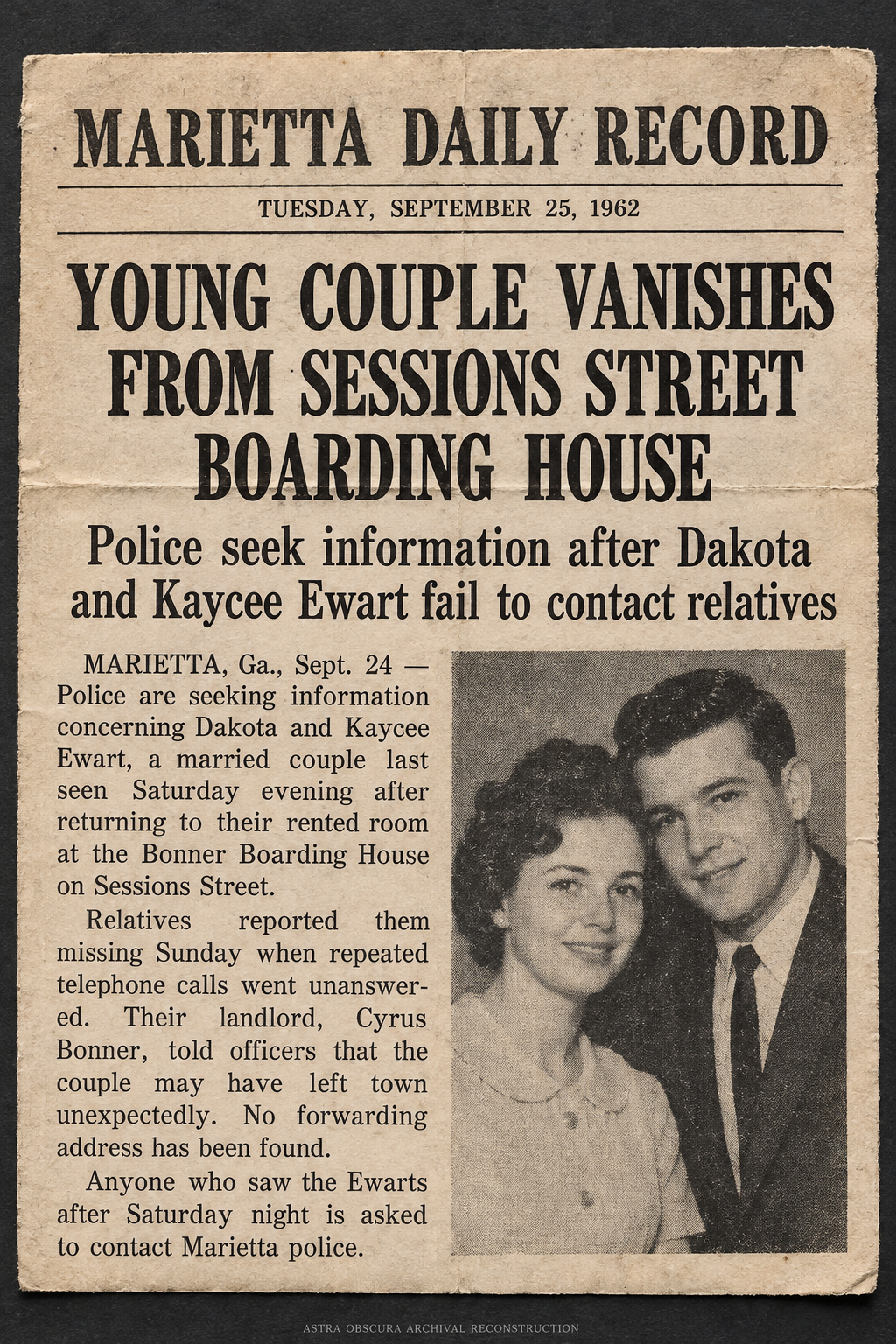
The first couple, Dakota and Kaycee Ewart, vanished in September 1962. Sadie and Everitt Garnier disappeared in October 1964. Both couples had rented rooms from Cyrus Bonner at the large corner house on Sessions Street.
The surviving newspaper coverage is thin. Stories that began on the front of the local section were reduced within days to brief notices asking readers for information. Reporters encountered missing records, reluctant witnesses and police officials unwilling to connect two cases without physical evidence.
Twenty-four years after the second disappearance, retired detective Hyram Goddard agreed to discuss the investigation on tape. His recollections supplied details that never appeared in print: the chemical odor in the house, a concealed staircase, two unsettling works of art and a stain that seemed to disappear when officers attempted to examine it.
Then, in October 2014, a small paranormal research group spent part of a night inside the vacant house. Their investigation ended earlier than planned. One member has now spoken with Astra Obscura about what drove them out.
None of this proves that the Sessions Street house was haunted. It does show why the people who entered it continued looking toward the turret long after they had left.
Listen to the deep dive
The Bonner Boarding House Disappearances · 25:28
Companion audio: the Bonner Boarding House disappearances.
Part One: The Disappearances
Dakota and Kaycee Ewart, 1962
Dakota and Kaycee Ewart arrived in Marietta in September 1962, intending to remain while Dakota pursued employment in the area. Family members later described the move as a fresh beginning rather than an attempt to escape trouble. They were young, recently settled and still in regular contact with relatives.
The Bonner Boarding House offered what they needed: a furnished room within walking distance of the square and a landlord willing to rent without a long lease.
The last confirmed public sighting of the Ewarts occurred during the evening of September 22. A bakery clerk remembered a well-dressed couple matching their description walking through Marietta Square. Another witness recalled Kaycee wearing glasses and a light-colored dress. Neither witness noticed an argument or anyone following them.
The couple returned to the boarding house that night.
What happened afterward was never established publicly.
Kaycee had promised to telephone her older sister the following Sunday. When no call came, the family initially assumed the couple was busy arranging their new life. Concern increased when a second call was missed and a letter sent to their Sessions Street address received no answer.
Cyrus Bonner told authorities that the Ewarts had left abruptly. He could not provide a forwarding address. He believed they had departed during the early morning, although no neighbor reported seeing them leave and no driver could be found who remembered collecting them.
No confirmed rail or bus record placed either Ewart outside Marietta. Their accounts showed no activity suggesting travel. Neither contacted family, requested employment records or retrieved mail forwarded from their previous address.
The earliest newspaper report treated the matter as a double disappearance. A later article used the phrase “possible foul play” but cited no blood, weapon, witness or recovered body. Police emphasized that adults had the right to leave without informing relatives.
A local reporter attempted to reconstruct the couple's final evening. She interviewed shopkeepers around the square, contacted transportation companies and asked whether other tenants had been staying at the Bonner house. Her notes repeatedly returned to the same difficulty: Bonner kept no formal guest register, and no other boarder could be located who would confirm seeing the Ewarts after they entered the house.
Within six weeks, regular newspaper coverage stopped.
The Ewarts remained missing.
Sadie and Everitt Garnier, 1964
Sadie and Everitt Garnier rented a room at the same house in October 1964. Everitt collected historical objects and kept a leather-bound journal. Their room reportedly contained Civil War photographs, old books and an antique surgical kit—details that later encouraged sensational accounts of the case but offered police no useful lead.
They were last reliably placed at the house on October 20.
Their automobile was subsequently found parked nearby. It was undamaged. Nothing visible from outside suggested a struggle. Cyrus Bonner again told police that his tenants had left without notice, this time claiming he assumed the couple had chosen to continue their travels.
The explanation did not satisfy Detective Hyram Goddard.
On November 9, Goddard and Officer Rigby Kennard visited the house. Bonner permitted them to enter and answered their questions. Because the officers did not yet possess evidence that a crime had occurred, their examination was limited by the terms of that consent.
Newspaper coverage reported only that police had spoken with the landlord and found nothing establishing foul play. A short follow-up stated that investigators were “continuing to pursue all reasonable inquiries.” No further public update appeared.
Behind the scenes, reporters noticed the earlier Ewart disappearance.
Caroline Mercer, then a county reporter, wrote in her unpublished notes that “two married couples do not vanish from one address by coincidence merely because the files have different numbers.” Her editor allowed her to mention the Ewarts in one article but removed a paragraph questioning whether Bonner should be considered a suspect.
Police would not publicly connect the investigations. The reasoning was defensible, if unsatisfying: there were no bodies, no identified crime scenes and no evidence showing that either couple had remained inside the house after the nights they were last seen.
Mercer continued working the story. She contacted relatives, searched court filings and attempted to identify former tenants. The deeper she looked, the less certain the record became. Dates conflicted. People remembered hearing that someone had vanished but could not say from whom they had heard it. One neighbor agreed to speak and then withdrew the next morning.
Mercer eventually wrote in the margin of her notes:
Everyone remembers the house. No one remembers seeing anyone leave it.
The Garnier case joined the Ewart file among Marietta's unresolved disappearances. Whether either was formally classified as homicide varied with the decade and the terminology used by the reviewing officer. Both remain unresolved.
Part Two: The Goddard Recording
In October 1988, twenty-four years after the Garnier disappearance, Caroline Mercer interviewed retired detective Hyram Goddard for a proposed retrospective. The full article was never published. Mercer retained the cassette with her case materials, and a digitized copy was recently made available to Astra Obscura.
The following transcript has been lightly edited for pauses, repeated words and portions rendered unintelligible by tape noise.
October 28, 1988
MERCER: What do you remember first about the house?
GODDARD: The cold. It was November, so that doesn't mean much by itself. But the front hall was colder than outside. Then there was a smell—lavender over something sharp. Cleaning solution, maybe bleach. I remember thinking somebody had worked hard to cover another odor.
MERCER: Did you suspect Cyrus Bonner immediately?
GODDARD: I suspected he knew more than he told us. That isn't the same as believing he killed them.
MERCER: What made you suspicious?
GODDARD: His answers were ready before I finished asking. He said the Garniers left suddenly. He couldn't tell us when they packed, how they carried their things or why their car was still nearby. When Kennard asked about the other tenants, Bonner said there weren't any. Just him and the house. Those were his words.
MERCER: Did that strike you as peculiar?
GODDARD: Everything struck me as peculiar. Peculiar doesn't get you a warrant.
MERCER: Officer Kennard discovered a hidden door?
GODDARD: Hidden is a strong word. There was a tapestry hanging in the den. Behind it was an old service staircase. The door had been made to sit nearly flush with the wall. If Kennard hadn't felt cold air behind the fabric, we might not have noticed it.
MERCER: Where did it lead?
GODDARD: Upstairs, then farther up toward the attic and turret. Bonner called it a servant's stair. In a house that age, that was believable.
MERCER: There have been stories about a painting showing some kind of ritual. Did you see it?
GODDARD: That's two different things people have joined together over the years. There was a painting of the house with a Civil War battle worked into the ground around it. Bonner said he painted that one. It was detailed—too detailed for my taste. Some of the figures didn't look like soldiers. They were too tall, too thin, as if they had been standing behind the battle and watching it.
MERCER: And the ritual?
GODDARD: That was the tapestry covering the stairway. It showed woods at dusk and a clearing marked by pale stones. There were figures at the tree line. You couldn't see their faces. I wouldn't swear it depicted a ritual. It looked more like they were waiting for one to begin.
MERCER: Did Bonner make the tapestry?
GODDARD: He said it had been in the house a long time. I don't know where it came from. I remember Kennard staring at it longer than he should have. I had to call his name twice.
MERCER: What did you find upstairs?
GODDARD: Mostly empty rooms. Dust. Furniture covered over. The attic looked unfinished. There was a room near the turret, but nothing inside gave us cause to tear into the walls or floors.
MERCER: Nothing?
GODDARD: Kennard saw a dark stain outside the Garniers' room. When he angled his flashlight toward it, he said it looked wet. I saw something too, but when we put the light directly on the carpet, there wasn't a mark.
MERCER: How does a stain disappear?
GODDARD: It doesn't.
MERCER: Then what did you see?
GODDARD: I don't know. Bad light. Worn carpet. Two men expecting to find something. Pick whichever answer lets you sleep.
MERCER: Did you return with a warrant?
GODDARD: We tried to build enough for one. A nervous landlord, an old staircase and a strange picture aren't probable cause. The Garniers were adults. Their car hadn't been damaged. We had no witness to violence and no physical evidence that survived examination. The request went nowhere.
MERCER: What about the Ewarts?
GODDARD: I pulled their file. It was thin. Bonner gave almost the same explanation: they left unexpectedly. No one could prove they hadn't.
MERCER: Two couples from one house.
GODDARD: I know what it sounds like now. I knew what it sounded like then. But you can't take a feeling before a judge.
MERCER: Do you believe the cases were connected?
GODDARD: Yes.
MERCER: Do you believe Cyrus Bonner was responsible?
[Six seconds of silence.]
GODDARD: I believe Cyrus Bonner removed evidence from that house. Whether he acted alone, I couldn't tell you.
MERCER: You mean he may have had an accomplice?
GODDARD: That isn't what I said.
MERCER: This interview may run near Halloween. Are you concerned people will treat it as a ghost story?
GODDARD: People tell ghost stories in October because they expect to stop believing them in November. I spent my career investigating people, not spirits. I still believe people killed the Ewarts and the Garniers.
MERCER: But something about the house troubles you.
GODDARD: Something about that house helped the truth stay hidden. Call that bad police work, fear, influence—call it whatever you please. I was there, and I don't have a better word for it.
MERCER: Have you ever gone back?
GODDARD: Not inside. I still pass the house occasionally. Every time I do, I find myself looking up at the window in the turret.
MERCER: Why that window?
[Goddard pauses.]
GODDARD: I don't know what I expected to find up there. I only know that when we left, I had the feeling we had overlooked the most important part of the house.
MERCER: Do you still feel that way?
GODDARD: Yes. Sometimes I think the answer was in that turret all along.
[Nine seconds of silence.]
GODDARD: Watching us leave.
The recording continues for less than a minute. Mercer asks whether Goddard wishes to add anything. He says no and then, before the tape stops, asks whether she intends to visit the house herself.
She tells him she has considered it.
“Go in daylight,” Goddard says.
Part Three: The 2014 Investigation
By 2014, the house had stood without a permanent resident for years. Television had made paranormal investigation familiar: small teams carried electromagnetic-field meters, digital recorders and infrared cameras into abandoned hospitals, hotels and private homes. Most nights produced hours of uneventful footage interrupted by an ambiguous sound or an unexplained fluctuation.
The Georgia Piedmont Research Group was one of many local organizations formed during that period. It consisted of four volunteers with ordinary jobs and a shared interest in allegedly haunted locations. The group did not charge property owners and never produced a television program. Its members posted occasional clips online and prepared private reports for those who invited them.
In October 2014, the group obtained written permission from a representative responsible for maintaining the Sessions Street property. They were allowed inside for one night, provided they caused no damage, lit no candles and left immediately if they encountered unsafe conditions.
Three members entered the house shortly after 9:00 p.m. They carried two video cameras, four digital audio recorders, an electromagnetic-field meter, an infrared thermometer and battery-powered lights. A fourth member remained outside to monitor the entrance and equipment cases.
The team planned to stay until 3:00 a.m.
They left shortly after midnight.
Astra Obscura located one participant, Erin Bell, in August 2026. Bell, now retired from nursing, agreed to discuss the investigation after reviewing surviving footage and her handwritten notes. A second former member declined to be interviewed. Attempts to locate the third were unsuccessful.
Bell does not describe herself as a medium and no longer participates in paranormal investigations.
Interview with Erin Bell, September 2026
ASTRA OBSCURA: What led your group to the Sessions Street house?
BELL: Marcus found a newspaper piece about the missing couples. It quoted part of the old Goddard interview—the line about the turret watching them leave. We thought it was Halloween language added by a reporter. We didn't know there was an actual recording.
ASTRA OBSCURA: Did you expect the house to be active?
BELL: We expected an old empty house. Old houses make noise. Wiring produces strange meter readings. Animals get into walls. We had done enough investigations to know that ninety-nine percent of what frightens people has an ordinary explanation.
ASTRA OBSCURA: What happened when you entered?
BELL: For the first hour, almost nothing. The power was off, so we used battery lights. The downstairs rooms were dusty but not ruined. Some furniture was still there. The tapestry was gone, but we found the narrow door behind where it had hung.
ASTRA OBSCURA: The concealed staircase described by Goddard?
BELL: Yes. It was narrower than I expected. Marcus went first. I followed with a recorder. Paul carried the camera behind me.
ASTRA OBSCURA: Did anything happen on the stairs?
BELL: Not that we noticed then. On the recording, there is a humming sound. Very low. Four or five notes repeated without a tune. It starts when Marcus reaches the second-floor landing and stops when I say his name.
ASTRA OBSCURA: Was anyone humming?
BELL: We asked each other that afterward. Everyone said no. But people make sounds without realizing it. That recording by itself proves nothing.
Bell provided Astra Obscura with a copy of the audio. The sound is present for approximately eleven seconds. It could be produced by a person, mechanical vibration or distortion introduced by the recorder. No voice can be distinguished.
The detail nevertheless carries an unsettling correspondence. An unpublished reconstruction of the 1962 Ewart case refers to a witness account of “low, tuneless humming” associated with the room where the couple stayed. There is no evidence the 2014 investigators had access to that material.
ASTRA OBSCURA: You also entered the crawlspace.
BELL: Briefly. There was an access door along the side of the house. It had been secured, but we had permission to open anything that wasn't nailed shut. Marcus crawled in first. I followed far enough to see his boots.
ASTRA OBSCURA: What made you stop?
BELL: The smell.
ASTRA OBSCURA: Sewage?
BELL: That was our first thought. Then maybe a dead animal. But it wasn't quite either one. It smelled wet and sweet, then rotten underneath. Marcus started gagging. I felt light-headed almost immediately. We had no masks and no way to test the air, so we backed out.
ASTRA OBSCURA: Did you report it?
BELL: We told the property representative the crawlspace needed to be checked by someone with proper equipment. He said moisture and animals were constant problems in an empty house. That was reasonable. We didn't argue.
ASTRA OBSCURA: Your notes say that someone knocked beneath the floor.
BELL: Paul wrote that. I remember three sounds while we were outside the crawlspace. They could have been Marcus moving the access cover. He said his hands weren't on it. Again, that doesn't make them supernatural.
ASTRA OBSCURA: What happened in the turret?
Bell remained silent for several seconds before answering.
BELL: We reached the attic a little after eleven. There was an unfinished room and another space beneath the turret. The turret room was empty. Not mostly empty—empty. Bare floor, bare walls, one window. We filmed the whole thing.
ASTRA OBSCURA: Did you experience anything unusual there?
BELL: I kept thinking someone was standing behind me. That's common in dark rooms. Your mind fills the space. What bothered me was Paul. He stopped filming and asked Marcus who had come upstairs with us.
ASTRA OBSCURA: There were only three of you inside.
BELL: Paul knew that. He said he'd seen a woman cross the landing below us. Marcus checked. No one was there. Our fourth member was still outside and appears continuously on the exterior camera.
ASTRA OBSCURA: Is the woman visible on the recording?
BELL: No. The camera was pointed into the turret room when Paul reacted. You only hear him ask the question.
The team remained upstairs for another seventeen minutes. Their readings showed brief fluctuations, but none exceeded what could plausibly be caused by the cameras, wiring or nearby electrical sources. The video contains dust, lens reflections and several unexplained noises, but no clear apparition.
At 12:07 a.m., the investigators began packing their equipment.
ASTRA OBSCURA: Why did you leave early?
BELL: We had stopped doing useful work. Paul was frightened and wouldn't go upstairs again. Marcus wanted to inspect the crawlspace from another entrance, but none of us thought that was safe. Then our outside person radioed that she could see somebody at the turret window.
ASTRA OBSCURA: While all three of you were downstairs?
BELL: We were in the front hall. The exterior camera shows us coming out less than a minute later.
ASTRA OBSCURA: What did she see?
BELL: A person—or the outline of one—standing behind the glass. She thought it was Paul because it looked narrow through the window. Then it moved backward.
ASTRA OBSCURA: Does the exterior recording show it?
BELL: There is a dark shape in the window for two frames. That's not evidence. Compression can do that. Reflections can do that.
ASTRA OBSCURA: Yet you ended the investigation.
BELL: Yes.
ASTRA OBSCURA: Why?
BELL: Because evidence wasn't what I wanted anymore.
Bell said the team reviewed the recordings twice and submitted a short report to the property representative. They classified the humming and turret image as unexplained but inconclusive. The crawlspace odor was listed as a potential environmental hazard requiring professional inspection.
The group did not return.
One surviving video contains a final exchange as the investigators load their equipment. The camera is aimed toward the driveway, leaving the house outside the frame.
“Did you lock the upstairs window?” someone asks.
Another member answers, “It wouldn't open.”
Several seconds later, glass can be heard sliding shut above them.
No one speaks for the remainder of the recording.
What Remains Unresolved
No surviving evidence establishes what happened to Dakota and Kaycee Ewart or Sadie and Everitt Garnier. The available record supports several facts: both couples stayed at the same boarding house, both vanished without later confirmed contact, and Cyrus Bonner gave similar explanations for their departures. It does not establish where they died, who killed them or where their remains were taken.
Goddard's recollections were recorded twenty-four years after the Garnier investigation. Memory changes, particularly when an unresolved case has been retold. The 2014 paranormal recordings are similarly limited. Low audio, odors in a neglected crawlspace and shapes in old windows can all have ordinary causes.
What gives the material its force is not any single anomaly. It is the repetition.
The house. The upper rooms. The concealed passage. The impression of someone watching from the turret.
Property records show that the house was sold in 2023. Astra Obscura is continuing to examine reports concerning the address after that sale. Those findings will be released separately when the available record can be responsibly reconstructed.
Until then, the Ewart and Garnier disappearances remain open.
On an October afternoon, I visited Sessions Street and stopped across from the house. I did not approach the property or attempt to contact its occupants. From the sidewalk, the turret window reflected the pale sky and the branches moving above the roof.
Nothing appeared behind the glass.
I watched long enough to be relieved.
Case Status
Dakota and Kaycee Ewart
Missing since September 22, 1962
Classification: Missing persons; suspected homicide
Status: Unresolved
Sadie and Everitt Garnier
Missing since October 20, 1964
Classification: Missing persons; suspected homicide
Status: Unresolved
Location shared by both cases: Bonner Boarding House, Sessions Street, Marietta, Georgia